
The Canard Digérateur

This is the third essay in our “artifact series” examining how modernity managed to domesticate everyday life. In this project, we’re exploring the limits of contemporary fundraising and what it will take to recover the power of wild generosity. To learn more about the project, visit here.
“Without the duck of Vaucanson, there would be nothing to remind us of the glory of France”— Voltaire
In the previous essay, we considered Laplace’s demon—a thought experiment that asked whether we could predict the future if we had the advantage of perfect knowledge of the present. That artifact promised to free us from uncertainty. It relocated risk into systems and made exposure feel avoidable. Prediction became synonymous with responsibility, and acting without guarantees began to look careless. The demon did not confine us; it promised to relieve us. It offered a world in which nothing need truly be chanced because everything could be calculated in advance. In doing so, it quietly diminished the necessity of action.
The second artifact operates differently. Where the demon promised to eliminate uncertainty, this one promises to eliminate something closer to home: it promises that we could eliminate the need for agency. If the first artifact reduced the burden of not knowing, this one reduces the burden of counting on anyone’s initiative.
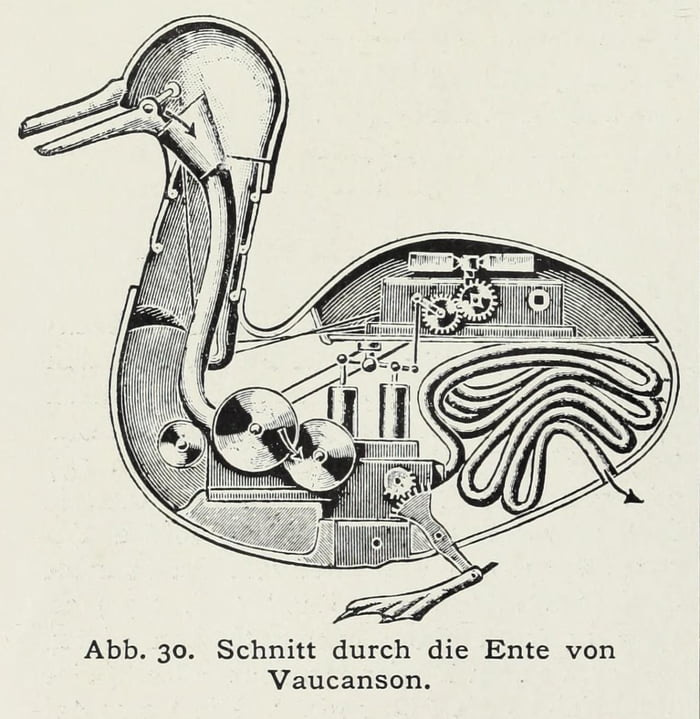
In 1739, Jacques de Vaucanson unveiled his Canard Digérateur, the Digesting Duck.
The Automaton
Vaucanson’s duck flapped its wings, dipped its beak, ate grain, and appeared to digest it. Mechanical toys were nothing new, but this machine unsettled people because it seemed to have something happening inside. It did not just move; it processed. It consumed grain and later excreted what looked like waste. Digestion, one of the most hidden biological processes, had been staged in brass and leather.
The duck did not actually digest. Hidden compartments and preloaded materials produced the effect. But the deception was not the point. Vaucanson was not trying to fool anyone into believing the duck was alive. He was demonstrating something more provocative: what appears to come from within could be produced by forces from outside. The duck was complex enough to provide a credible imitation of life. And, if the imitation was credible, then perhaps what happens inside was not necessary. Perhaps what looked like life expressing itself was just matter arranged in motion.
Here is what historian Jessica Riskin helps us see. The fascination with automata reflected a deeper argument about nature. Was the world animated from within, or was it matter moved by forces from outside? If living beings had some interior source, some vital force, some animating principle, then life was fundamentally different from mechanism. But, if life could be reproduced through external forces alone, then the distinction collapsed.
The stakes were not abstract. If nature operates mechanically—if what looks like something coming from within is actually just external arrangement—then human beings are not fundamentally different from other matter. Moral responsibility, free will, the capacity for genuine choice—all of these depend on something coming from within. The duck did not resolve these questions, but it made the mechanistic answer plausible enough that institutions could organize around it.
The duck entered that argument not as proof, but as plausibility. It did not settle the question. It made one answer feel increasingly credible. If digestion could be reduced to cams and pipes then perhaps life itself did not require an interior source.
What was at stake was agency. Early modern mechanism increasingly described the world as passive—matter moved by forces, not animated by anything inside. The Canard Digérateur functioned as an argument in brass. It demonstrated that life’s most intimate processes could be simulated mechanically. And, if they could be simulated, then perhaps they were nothing more than mechanism. Agency, the capacity to start something, became unnecessary.
The Subtraction Story
Like Laplace’s demon, the Digesting Duck tells a subtraction story. The demon suggested that uncertainty was temporary and therefore suspect. The duck suggested that agency was unnecessary and therefore dispensable.
The claim is simple. What appears to arise from within is redescribed as the product of external forces. What looks like initiative is reframed as response. If behavior can be fully explained by inputs and outputs, then intrinsic agency drops away.
The subtraction happens quietly. No one announces that people lack the capacity to initiate. We just stop needing that explanation. Agency recedes not because it has been disproven, but because it is no longer required to make sense of what we observe.
What disappears is the idea that people can take initiative—that action can arise rather than merely follow. In a mechanical description, movement always traces backward to prior causes. There are chains of reaction but no centers of initiative. The world becomes a field of responses.
In place of agency appear systems of observation and measurement: performance metrics, productivity indicators, behavioral analytics. These frameworks assume activity is intelligible from the outside. You need not encounter a person as a source. You need only assess outputs.
We do not abolish agency. We simply stop building systems that depend on it. This proves especially convenient in domains where scale matters more than depth. If you assume people respond to arranged forces you can standardize approach, measure outcomes, and train staff in repeatable techniques. The assumption makes large-scale coordination possible. And, once institutions are built around it, the assumption becomes invisible.
Here is where the mechanistic assumption becomes hard to see. It does not announce itself as mechanism. It presents itself as responsibility. Once systems are designed to get people to behave in certain ways those behaviors get turned into moral requirements. We stop saying, “the system needs this response” and start saying, “people should act this way.” A reporting framework becomes “accountability.” A response rate becomes “engagement.” A managed outcome becomes “impact.”
The engineering disappears behind moral language. And, once a requirement sounds like values rather than mechanics, challenging it feels like denying that you care. The moral language makes it hard to question the system.
The same assumption quietly underwrites modern consumer logic. If behavior can be explained as the product of arranged forces, then desire itself becomes something that can be shaped from the outside. Preferences can be nudged. Attention can be directed. Choices can be optimized through environment design. You do not need to rely on intrinsic initiative if external stimuli are sufficient. In fact, trusting interior will begins to look inefficient.
Over time, this shifts how we approach persons. We design incentives instead of cultivating judgment. We engineer friction and ease rather than form character. The consumer is treated less as a self-originating moral agent and more as a responsive node inside a behavioral system. What the Duck made plausible in brass becomes ordinary in markets: arrange the environment correctly, and the behavior will follow.
The Preference for Simulation
In the 1960s, computer scientist Joseph Weizenbaum created ELIZA — a simple program that mimicked a therapist. A user would type, “I feel anxious,” and the program would respond, “Why do you feel anxious?” The system relied on pattern matching and scripted prompts. There was no comprehension, no consciousness, nothing happening inside—only response.
Yet users confided in it. They attributed understanding to it. They felt heard.
Weizenbaum was unsettled not because the program worked, but because people were satisfied by it. This became known as the Eliza Effect: our tendency to attribute interior life to systems that simulate responsiveness. When the surface behaves right we supply the missing depth ourselves.
Sherry Turkle shows us what follows. Decades after ELIZA, as sociable robots and conversational agents proliferated, she observed what she called the robotic moment—the threshold at which simulated intimacy becomes not just acceptable but preferable.
The issue is not whether machines are conscious. It is whether consciousness matters to us. And what Turkle found is striking: people do not simply tolerate the absence of interior life. They prefer it.
Here is why. Real people interrupt. They introduce something unscripted. They possess alterity—the stubborn fact that they are not you, that they might introduce something that requires you to change. A responsive system removes that burden. It offers engagement without the risk that another will unsettle what you have arranged.
Simulation provides responsiveness without resistance. A program reflects but does not contradict. Where living people introduce unpredictability, simulation offers stability. You get connection without encounter, recognition without being known, the appearance of relationship without the demand of one.
If agency has already been set aside in understanding, its absence in interaction feels natural. We grow accustomed to responsiveness without people actually starting things. We practice projection rather than recognition. The distinction between someone and something does not collapse through argument. It erodes through preference.
What Is Lost
The duck did not eliminate digestion. ELIZA did not eliminate conversation. What they eliminated was the need to believe that either required something arising from within.
That shift did not remain theoretical. Once it becomes plausible that behavior can be explained entirely by external forces, institutions quietly reorganize themselves around that assumption. Systems are built to arrange inputs and elicit outputs. Environments are structured to produce responses. Incentives replace initiative. Structure replaces judgment. We begin to assume that if the right conditions are engineered, the right behaviors will follow.
What recedes in that world is not activity. There is plenty of activity. What recedes is the expectation that someone might genuinely begin something. We stop designing spaces that depend on initiative and start designing mechanisms that depend on compliance. Action gives way to response.
Another loss follows, and it is rarely named. When intrinsic motivation is no longer trusted, action must be continually stimulated. Systems must prompt, incentivize, monitor, and reinforce. The burden shifts to design and supervision. What disappears is the quiet efficiency of self-directed action — the kind that does not require activation because it arises from within. A world built entirely on external arrangement can produce behavior, but it must constantly work to do so.
Over time, this reorientation becomes invisible. We no longer notice that our systems presume people are moved rather than moving. We measure engagement instead of encountering persons. We optimize flows instead of inviting beginnings. We prize responsiveness over initiative because responsiveness can be counted.
The loss is subtle but decisive. When we cease to build for beginnings, we cease to expect them. When we stop expecting them, we stop cultivating the courage required to act. What remains is a great deal of motion without origination. Activity continues. Programs run. Metrics improve. But the space in which someone might step forward, take the risk, and alter the trajectory of a shared world quietly narrows.
The mechanical duck was not merely a marvel. It was a mirror. It reflected a vision of life in which nothing genuinely begins, only responds. And once that vision takes hold, institutions no longer need to ask whether someone will act. They only need to determine how to arrange the forces that will move them.
- Jason Lewis, Partner & Chief Innovation Officer at Seed
Taming the Gift is a collaboration with Seed, born of a shared commitment to understanding the limits of contemporary fundraising and to reimagining practices that activate cultures of wild generosity.