
Taming of the Gift

Taming the Gift is a project about what happens when the gift is pulled out of the human conditions that once gave it meaning and remade to fit the needs of modern systems. The social sector did not invent this process, but it has become one of the places where its most sophisticated forms now appear.
Many of the debates inside institutional philanthropy and professional fundraising sit downstream of what these essays explore. Messaging strategies, segmentation models, engagement journeys, predictive analytics, strategic philanthropy, impact frameworks, and theory of change models all belong to that level of conversation. This series asks something more fundamental: what kind of human activity is a gift, and what happens when it is disembedded from proximity, encounter, obligation, memory, and wonder?
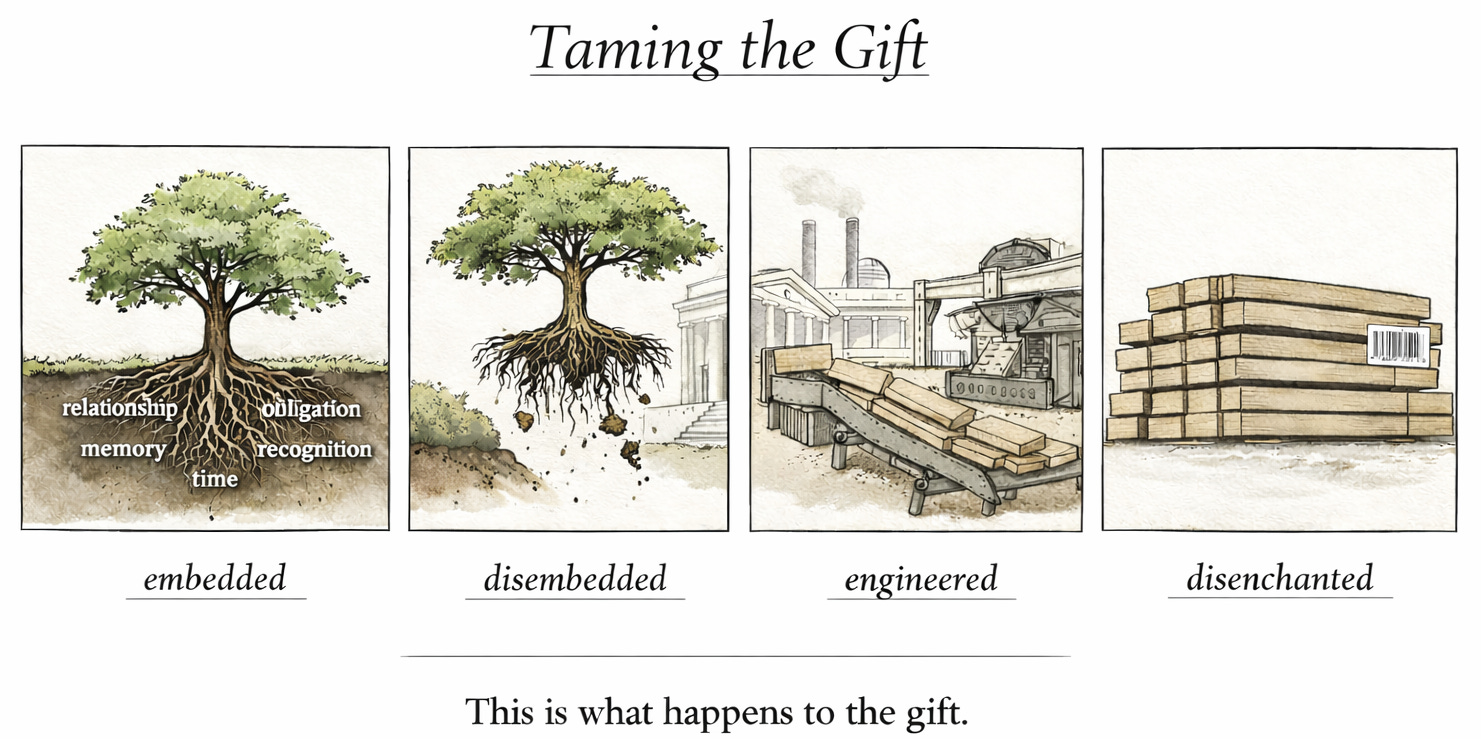
The project works through three braided lenses. Gift theory gives us the object, drawing on a long tradition of thought about what the gift is and how it has been understood across human societies. Complexity gives us the mechanism, naming why systems built on relationship resist the engineering programs imposed on them. Ecology gives us the practice, recovering a vocabulary of tending, cultivation, and the slow conditions under which living things grow. The argument proceeds from inside the institutions where the costs of these forces are felt, drawing on the experience of those who have worked the terrain the longest.
Our working assumption is simple. The gift does not emerge as a transaction, a metric, or a technique. It begins embedded in thick human realities. But once institutions try to make it portable, manageable, and scalable, something changes. The gift can be engineered, disembedded, and eventually disenchanted. It may become more legible, more efficient, and more controllable, while also becoming harder to recognize and harder to experience as a gift.
That loss is often interpreted as donor fatigue, apathy, declining participation, or changing philanthropic preference. These essays suggest another possibility. What looks like withdrawal may be a form of feedback. The retreat of everyday giving may reveal that the system itself has become inhospitable to the gift.
The distinction that matters is not between quality and quantity but between quantity and form. The gift is a form before it is anything else. It is a shaped relation with its own proportion, its own obligation, its own timing, a whole whose parts answer to one another. What makes a gift a gift rather than a transfer is not the magnitude that moves but the form the movement takes. The apparatus that runs the sector perceives quantity and very little else, and so the slow substitution of the gift’s quantity for its form goes unregistered, because the instrument that would notice the loss is the same instrument performing it.
The work often feels thin not because people lack conviction, but because systems quietly reward compliance over courage, measurement over encounter, and institutional legitimacy over relational presence. This is not primarily a reform agenda. It is an attempt to see clearly, to distinguish the machinery from the work itself, and to notice where the container has slowly been mistaken for the care it was meant to hold. What happens when the gift is uprooted, processed, and standardized? And what would it take to recover the gift as something relational, risky, and alive?
These essays do not make their case by accusation. The reader this project has in mind is not a bystander to what is described here but someone who has worked inside these systems, believed in them, and perhaps already sensed that something was missing without having the language to name it. A direct indictment would let that reader off too easily: it would produce guilt or defensiveness rather than recognition. The argument is built slowly and by accumulation, the way a case is made when what is at stake is not just a conclusion but a way of seeing. When the loss finally comes into focus, the aim is that it arrives not as a verdict but as something the reader has half-known for a long time.
Part One: The Domesticated Gift
The first half of the project focuses on diagnosis and genealogy. It begins by examining what it feels like to work inside modern systems that require everything to be visible, measurable, and contained. In such environments, uncertainty is treated as failure and judgment is gradually displaced by procedure. From there, the essays trace the deeper intellectual architecture that made these systems possible.
Modern life, we argue, has gradually become a machine for taming what was once wild, relational, and unpredictable. Three forces shape this transformation. Engineering processes the gift into forms that can be managed at scale. Disembedding lifts it out of its social and moral context. Disenchantment drains away the mystery, risk, and meaning that once made the gift more than a transfer of resources.
The essays follow how these forces took shape in modern culture through a series of artifacts and ideas, including dreams of perfect prediction, mechanical simulations of life, and architectures of constant visibility. Together they form many of the background assumptions of contemporary institutions, including the nonprofit sector. Only once these waters become visible can we begin to ask the deeper question that follows: what happens to the gift when it must live inside them?
Chapter One


Chapter Two


Chapter Three


Chapter Four


Chapter Five


Part Two: Wild Generosity
The second half of the series turns toward remembering and recovery. It begins from a simple observation. The gift cannot survive abstraction. It lives in the particular. The gift takes shape between real people, in real places, in response to needs as they are lived.
The aim is not to abandon modern institutions or the systems that sustain them. Institutions require coordination and responsibility. The challenge is different. The systems we have built must become conscious again. They must be understood as tools that serve the gift rather than structures that quietly contain it.
These essays ask what it might mean to re-member the gift. The word is used intentionally. To re-member is to gather what has been separated and restore it to living relationship. The work ahead is not innovation but recovery. It is the slow rediscovery of the relational encounters that allow the gift to feel alive again.


