
Silicon Valley Can’t See Half the Social Sector


In the last week a number of my colleagues have been reading, sharing, and commenting on an essay by Nan Ransohoff. I have been tagged in it more than once by people who suspect that I share their skepticism. I do. And, curiously, Ransohoff’s essay has reminded me of something I watch happen in my classroom every semester.
Ransohoff’s essay is about the money she expects to arrive in the sector. The fortunes being built in AI are poised to become liquid, and she estimates that this could mean somewhere between thirty-seven and a hundred billion dollars a year in new philanthropic dollars. This money, she argues, comes from people who built companies, who prize talent and speed, and who doubt the existing sector can absorb capital at that scale or move it fast enough. So she argues that we will need new organizations to receive it: philanthropic startups, run with the intensity of technology companies, and funded by a new class of philanthropic venture capitalists like a Silicon Valley for public goods, built quickly.
It is an ambitious vision and a sincere one. My reservation is simple. Ransohoff wants to direct an enormous new flow of capital into the one corner of the sector that is arguably already overbuilt while the other corners go overlooked. To see why, I have to start in the classroom.
I teach a nonprofit management course, sometimes two sections, each semester. Students begin with a purpose essay, an assignment that pushes them past “follow your passion” toward something sturdier: the recognition that purpose, unlike passion, is durable enough to build a life of work on. Then they find a nonprofit that aligns with this purpose, one they can study up close and partner with to complete their field research. Over the years that adds up to hundreds of organizations passing through the course.
In week three we discuss why the social sector exists in the first place. We work from excerpts of Peter Frumkin’s On Being Nonprofit, a book I first read in graduate school and have taught ever since. Frumkin lays out four rationales for the sector, organized on two axes. The vertical axis runs from instrumental at the top, where an organization is a vehicle for producing an outcome you can measure, to expressive at the bottom, where the organization exists because belonging to it is the point. The horizontal axis runs from the demand side to the supply side. The four rationales fall out of those axes: service delivery and social entrepreneurship in the instrumental half, civic and political engagement and values and faith in the expressive half. We spend the week sorting real organizations into the four and learning to see the whole sector rather than one part of it.
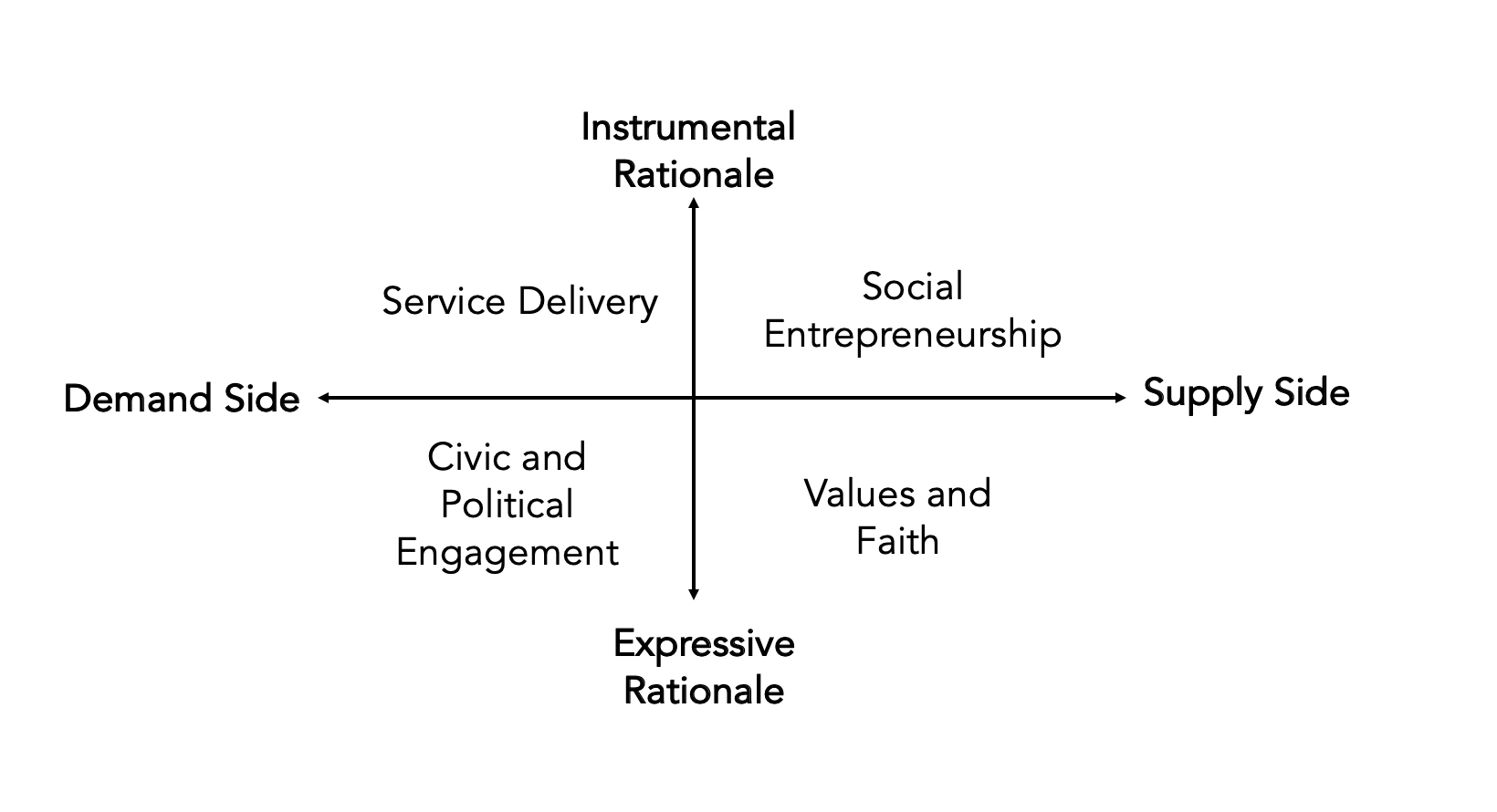
By midterm presentations, the same thing happens every semester. The organizations my students know best, and the ones they choose to partner with, cluster in one corner: service delivery such as food pantries, mentorship programs, after-school programs, a sanctuary for retired horses. These service delivery organizations are one corner of the instrumental half. Very few engage with the expressive half. There is no lodge, no congregation, no veterans’ post, no membership club. The work concentrates in the same corner term after term.
My students are not deliberately overlooking the expressive half. They are encountering what has been a reality of our sector since the civil rights movement.
Ransohoff is looking at the same single corner of the sector my students gravitate toward, and mistaking it for the whole. The organizations Ransohoff’s essay says we need are larger, faster, more scalable, and far better funded. But they sit in the same place on Frumkin’s map: service delivery. A philanthropic startup is a service-delivery organization with a venture budget. Ransohoff is not proposing a new part of the sector. The proposal is a bigger, faster version of the corner my students already cannot see past, and the corner we have already overbuilt.
Frumkin saw the trouble with that part clearly and gave it a name: vendorism. When service-delivery organizations come to depend on outside funding they lose their independence, fixate on the scale of what they provide, and start to look like one another until the variety of what the sector offers thins out. The corner Ransohoff wants to fill with tens of billions of dollars is the corner whose central problem is what happens when you fill it with outside money. The prescription is the disease.
The cost of that consolidation is becoming visible, though we tend to name its symptoms separately. We talk about a sector ripe for mergers as though the interchangeability of service-delivery organizations are a sign of efficiency to be captured rather than evidence that everything has crowded into one corner. We talk about fragmentation: organizations competing for the same funders rather than building something together. And we have just watched a federal administration unwind six decades of public-subsidy dependency with startling ease. That last one should have triggered the alarm. A sector built on membership has a constituency that shows up to defend it. A sector built on service delivery and outside funding has clients and a revenue stream, and when the funding is threatened there is no one who figuratively owns the sector. The defenselessness was not bad luck. It was the predictable condition of a sector that had consolidated itself into the one corner that cannot generate countervailing power.
If this were Ransohoff’s blind spot alone it would not be worth an essay. What makes it worth attention is how Ransohoff’s essay was received, shared, and praised both by people who run nonprofits and by people who have never worked in one. An essay circulates that way not because it changes minds but because it confidently tells readers what they already believe. It returned to the sector its own assumptions at enormous scale, and the sector was glad to have them. People inside heard that the money and talent they were told they lacked were on the way. People outside heard that the skills they already have, building fast and scaling hard, are what the hardest problems require. Both were told there was no other part of the sector to learn. I understand why that was a relief, especially to people who have worked for years inside the overbuilt corner. But the eagerness of the response is itself the diagnosis. A sector that could still feel the absence of the expressive half would not greet a service-delivery manifesto with relief.
There is a plainer reason this money doesn’t reach the expressive half. These organizations were never funded the way Ransohoff imagines. The veterans’ post and the neighborhood association did not wait for someone else’s check; they waited for members. The congregation did not pitch a funder; it held people who showed up, and it counted on their offerings rather than outside grants. In the expressive half, the money flows from the members, not, as Ransohoff proposes, from funders and allocators responding to highly legible problems. There is no startup to back and no outcome to scale, only people choosing to show up for one another, and that is not something that starts with a check.
I might be making too much of a map that I teach every semester. So it is worth noticing who else has reached the same conclusion lately, from very different starting points, and how each might respond to Ransohoff directly.
Leah Hunt-Hendrix and Astra Taylor, in Solidarity, might say that Ransohoff’s proposal funds the wrong thing in the wrong way. What changes a society, they argue, is solidarity, the power people build with one another rather than receive from above; and grant funding undercuts it. The money flows in one direction, from giver to grantee, and sets organizations competing for the same dollars, each pressed to look distinctive, until groups that should stand together are weakened and split apart. A wave of philanthropic startups competing for allocator attention is, by their account, a machine for producing exactly that weakness.
David Brooks, who has argued that the country needs a new mass movement, might say Ransohoff is funding the wrong shape of thing. What a fractured society needs is a broad, cross-class membership movement on the order of the civil rights era. You do not build that with venture capital and requests for startups. You build it through membership; and Ransohoff’s vision has no place for members, only founders, funders, and clients.
Michael Lind, in The New Class War, might put it most bluntly: this money cannot do what Ransohoff wants because of where it comes from. Ordinary people, he argues, have lost the countervailing power they once held through unions, churches, and mass-membership organizations, the institutions that let them push back against a managerial elite. Donor-funded groups are no substitute because real countervailing power runs on the dues of its members, and the wealthy cannot fund the very thing whose purpose is to check the wealthy.
Set these three beside one another. They are very different voices describing the same absence. One calls it solidarity, one calls it a mass movement, one calls it countervailing power; and all three are pointing at the expressive, membership-based, dues-funded half of the sector where people are bound to one another rather than served or funded or deployed. It is the bottom half of Frumkin’s map. It is the half my students cannot find. And it is the half Ransohoff does not see.
That is what the essay finally comes down to. The half of the sector my students struggle to find, the half that is hardest to encounter because it depends on people showing up for one another rather than on anyone writing a check, is the same half missing from Ransohoff’s account of the future. It has been overlooked, misunderstood, and badly under-leveraged; and now more than ever, it alone can do exactly what the moment demands. The money will build a great deal. It will not build that. Our task is not to fund our way past that half of the sector. It is to rediscover it.
- Jason Lewis, Partner & Chief Innovation Officer at Seed
Hear, hear! I experienced this firsthand as a board member of a nonprofit arthouse cinema in San Francisco (shoutout to The Roxie!). It thrives because patrons and members make it so; even "outside money" in the form of larger donations has the membership vibe. Belonging is the secret sauce that members of the Philanthropic Industrial Complex overlook because they themselves aren't members of the communities they fund.
When talking about the mental health field, I used to break problems down into two buckets: "scarcity" problems and "engineering" problems. Engineering problems are anything to do with the throughput of people, money, and services. Scarcity problems are about the amount and distribution of resources. There's a third bucket, of course, which roughly corresponds with the "expressive" idea in the piece: what I would sometimes call "metaphysical" problems having to do with the social/cultural conditions in which we are all formed. The challenge of the third bucket is that those conditions are impossible for any central actor, philanthropy, government, or otherwise, to control or engineer.
All three buckets are important, but solving for engineering problems without considering the other two is doomed to hit a hard ceiling of impact. Ransohoff's vision of applying "tech talent" to social problems in her third wave runs headfirst into this problem. Tech can solve important engineering challenges in impactful ways, but that is about all it can do.
Anyway, excellent piece. Thank you for it.